

Why read books?
What does it matter?

Reading books often doesn't get the credit it deserves. When you read, you can learn a wealth of knowledge that the author spent years gathering in just a few weeks.
You don't have to agree with the author's ideas, but the more you read, the more you realize that different authors can have VERY different opinions about the same topic. This broadens your perspective and encourages you to see the world from someone else's viewpoint.
In this day and age, where everyone is in a hurry, many will say they are too busy to read. But they will spend hours on FB, which often results in getting embroiled in someone’s whinges, victimizing about something trivial, or sharing their daily woes. The negativity is contagious.
Magazines are a good read if you subscribe to the good ones, but which one should you subscribe to? Many are filled with articles which rehash previous topics, so it maybe hard to find something new or relevant. Here is a good read I picked up on recently.
Chances are, there is more you want to know after reading an article. It inspires you to search further. A good book can help you in this search. Here is a look inside one of the pages of The Thinking Horse Breeder.
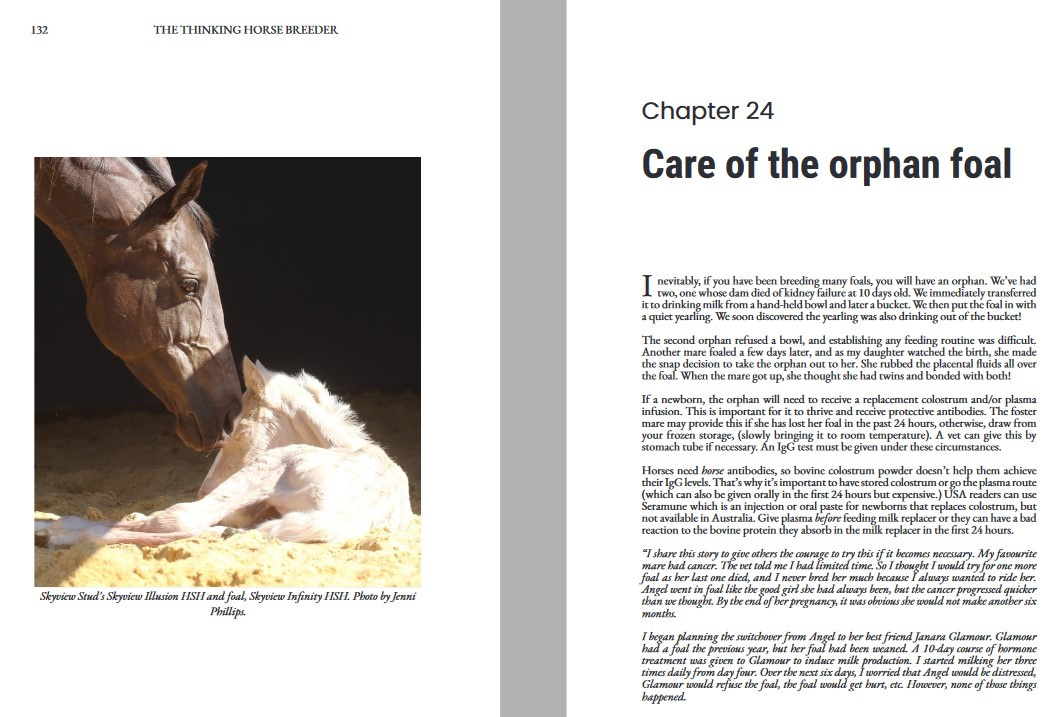
The thing is, a good book is a treasure, something to immerse yourself in at the time, and if it is about your favorite topic, something to re-read again for new insights; something that each time you read it, you discover new treasures you hadn’t fully understood which can take you to the next level, or you revisit something which is relevant to “just now.” Some little snippet you had forgotten is now valuable for your current situation.. This is what sets a good book apart from others you might read, or from magazines, where you have now lost the article, or will unlikely go back to it.
A good non-fiction book, a text, will have you learning in such a way that is sounds like the author is speaking directly to you, the reader. It will answer questions which you hadn’t even thought of, and give you information which you likely didn’t think you needed to know. It will expand your horizons, and cause you to question your own methods which you have always used, successfully or otherwise. In a conversation with the reader, an author achieves a relationship, hopefully striking a chord, but always causing the reader to consider their own beliefs and actions.
This was my aim for readers of The Thinking Horse Breeder, and indeed the feedback I am getting is just that…..the book has helped readers to assess and rethink their own journey into the world of breeding horses. I am indeed humbled by this. Thank you to those who are sharing the journey. It can only benefit the horses.
DID YOU KNOW?
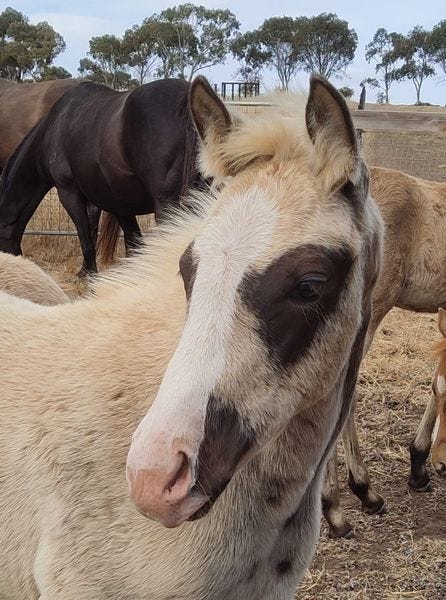
Foals from about six weeks old, start losing their foal coats. They are usually born paler than their eventual colour which is thought to be a form of camouflage. As they lose their coat it forms “goggles” around their eyes. These goggles can be spectacular.
Here is one born at Chalani this year, a pale white palomino, whose goggles are chocolate. She is still a palomino. The extra dark colouring is thought to be from milk protein, as they usually don’t darken up that colour permanently. Palominos are particularly sensitive to changes in protein levels, and will often be different shades each season
Enjoy your Friday.